To Enjoy the Jet Stream System Comfortably
At TOYO REELS, we are committed to supporting you even after your purchase.
We will provide guidance to ensure that you can enjoy using your reel smoothly and trouble-free.
Proper line management is essential. (Key Point #1)
The Middle Finger is the Key
To maintain a firm grip on the rod while holding the line between your index and middle fingers, it’s important to stabilize your fingers.
For better line control, do not place your middle finger directly on the rod (grip). Instead, stack it over your index finger—this helps secure the line more reliably.
You could also describe this method as: grip the rod using your thumb and middle finger, while sandwiching the index finger and line underneath the middle finger.
⚠️ If the middle finger touches the grip directly, you may not notice when the line tension drops. Lifting the middle finger off the grip helps prevent this issue.
It’s a very subtle adjustment, but crucial for effective line control.
Some people experience finger cramps at first, but please be sure to master this technique properly.
Hooking Is About Resisting the Spool’s Reverse Rotation (Key Point #2)
In conventional fly fishing, it’s common to hook the fish by pulling the line.
However, with the JET STREAM, pulling the cable won’t effectively drive the hook in, because the front drag system is activated, absorbing the pulling force.
Please understand that with this system, hook sets will not be strong when using the pull method alone.
In short, the key to hooking with the JET STREAM is preventing the spool from rotating backward, rather than just pulling the line.g does not work well.
When using the JET STREAM, stop the spool from spinning backward with your palm or hand while setting the hook with your rod.
Because this hooking method—stopping the spool during the hookset—is easy to forget for beginners, be sure to consciously practice it from the very beginning. Many users tend to overlook this step, so make it a habit to stop the spool whenever you set the hook.
How to Operate the FALCON Slide Lock System (Formerly HAYABUSA and GALAXY)
If the reel body moves when you pull the thruster strings, try changing the direction in which you pull.
Pull the thruster strings in a direction that counteracts the force and allows for a more stable retrieve.
When Wearing a Jacket with Tight Cuffs
If you are wearing a jacket or shirt with cuffs that fit snugly around your wrist, you don’t need to slide the reel up and down as shown in the video.
You can operate the reel’s turning function (turning ON/OFF) while keeping it fixed in the lock position.
When Wearing a Jacket with Loose Cuffs
In contrast, if your clothing has loose or wide cuffs, the line may occasionally hit your sleeve during the cast.
Here is the recommended sequence when using such clothing:
- After finishing a retrieve in the locked position,
- Slide the reel down to the lower position,
- Flip the reel using the wing mechanism,
- Then cast,
- Return the reel to the lock position,
- Begin the retrieve again.
Repeat this cast & retrieve sequence.
Although it may sound complicated in writing, your fingers and hands will quickly get used to the flow.
Once mastered, you’ll be able to cast and retrieve smoothly and unconsciously, even at high speed.
Important Notes When a Fish Strikes (Using FALCON Wing)
When a fish strikes, firmly tighten the tension nut to prevent the reel from shifting out of the lock position.
(Tighten it as hard as you can.)
If the tension nut is not fully tightened, and you stop the spool by gripping the spool handle during a fight with a big fish, the rod may shake violently.
This can cause the reel to gradually rotate out of the lock position with the spool handle as the pivot point.
Please be very careful of this.
Line Handling Without the Single-Hand Line Guide Attachment or FOV Guide Bar on a Double-Handed Rod
→ How to Manage the Line When Using a Double-Handed Rod Without the Single-Hand Line Guide Attachment or FOV Guide Bar
Spiral Mode with Single-Hand Rod Using Hauling Action
Focus on the compact casting stroke. Precision over power.
Osprey & Raptor Single-Hand Line Guide Attachment (Standard on FALCON)
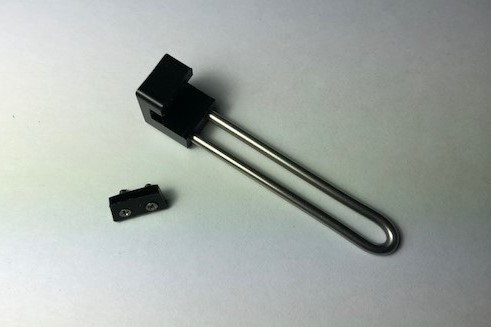
When using OSPREY or RAPTOR with a single hand, it is recommended to install a line guide attachment. We accept the option price of 1,500 JPY
How to Replace the Recoil Thruster Strings
Note:
Starting with models sold in April 2025 and later, the internal structure has been completely redesigned.
In the video, please replace the term “D-cut” with “slit” to reflect this change.
Regarding the Thruster Strings to Use:
For those who purchased before April 2025, please set it up with either two 30-lb PE lines or three 20-lb PE lines (total effective strength: 60 lb).e recoil thruster strings.
For customers who purchased the product in or after April 2025, please set it up with two 120-lb PE lines (total effective strength: 240 lb).
Caution!
For left-hand retrieve models, the spool rotates in the opposite (counterclockwise) direction compared to the demonstration in this video. Please be aware of this difference.
Thruster Strings are consumables and must be replaced regularly.
Metal materials cannot be used.
To reduce friction resistance on the Thruster Strings, we recommend using fly line dressing.
By applying fly line dressing frequently—ensuring it doesn’t dry out—you can significantly extend the lifespan of the Thruster Strings and reduce how often they need replacement.

For Customers Who Purchased Before April 2025
Models Released Before April 2025
We currently recommend using nylon line for models sold before April 2025.
Although PE-type lines or Kevlar materials can also be used, there is no significant performance difference. (Note: Fluorocarbon lines are not suitable.)
Please replace the line once it becomes frayed or visibly worn.
Even if the Thruster Strings break during use, they can be repaired on-site without any tools by following the steps shown in the video.
However, we highly recommend replacing the strings at home every 2–3 fishing trips as a preventative measure.
While we suggest “every 2 trips” as a general guideline, the actual lifespan of the Thruster Strings can vary greatly depending on the fishing environment.
For example, in light-duty use with low-load conditions, they may last for over 10 days.
On the other hand, if you’re using a high-weight fly line in fast-moving water with continuous tension applied to the strings, they may not even last two days.
We strongly recommend estimating the replacement interval based on your fishing frequency and usage conditions, and replacing the strings at home before they break—especially because nylon line wear is hard to detect visually.
Recommended Replacement Line
(For models sold before April 2025)
- When using 20 lb nylon line: Use 3 strands
- When using 30 lb nylon line: Use 2 strands
eplacement Line for Models Sold After April 2025
You may also choose to pre-cut and knot the strings using the line below and carry them as spare sets for on-site replacement:
APPLAUD GT-R ULTRA(20LB×3:30LB×2)
Sanyo Nylon Applaud GTR Ultra (Product Page)
For models sold after April 2025, please use two strands of 120 lb PE line.
Be sure to apply Fly Line Dressing thoroughly during use.
Replace the line once the surface becomes frayed or fuzzy.
We currently recommend the following line for replacement use:
ODDPORT WX P-1 8(120LB×2)
https://xbraidygk.jp/products/oddport/
💧 Waterproof Design & Saltwater Use
The reel is designed with a waterproof structure, so brief submersion, such as during photo shooting, will not result in water intrusion.
While it is safe to use in saltwater, if the reel is left submerged under water pressure for an extended time, we recommend rinsing the bearings with fresh water afterward, just to be safe.
Please check whether the included anti-rust oil has sufficiently penetrated the internal bearings. If it appears diluted, reapply oil as necessary.
🔧 Reel Maintenance Instructions
If used in saltwater, always rinse thoroughly with fresh water, regardless of usage time.
After rinsing, be sure to apply the included anti-rust agent to the bearings and screws.
Even leaving the reel unwashed for just one day can result in rust and corrosion.
- In mild cases, cleaning with oil may restore function.
- In severe cases, replacement of internal parts may be required, which could lead to significant repair costs.
To avoid such issues, always perform maintenance promptly.
Even in freshwater, if the reel is submerged for a long time (e.g. during deep wading where the reel stays underwater), the anti-rust coating may wash away, leading to potential corrosion.
In such cases, we recommend reapplying anti-rust oil hourly during use.
Note for International Shipments:
Due to air cargo regulations, anti-rust agents and maintenance oils mentioned in the instructions above are not included with international shipments.
Please obtain these items locally in your country.